


Case Study: Hysteric Glamour The History of Hysteric Glamour: A Deep Dive into the Archive
- Taneya Prince
- Sep 4, 2021
- 5 min read
In the world of street fashion there are those who replicate what were already made and then there are the originators. In recent times many people have opted for the originators, looking to expand their archive with original pieces from designers of the 90’s or whichever time period. In this day and age, with trends coming and going, it can be hard for certain brands to stick around. However, through the rise and fall of trend popularity, the “originators’” credibility and art never fades away.
As many in the fashion world know, Japan has always been a hot spot for notable brands such as BAPE, NEIGHBORHOOD, UNDERCOVER, and SACAI. But among these innovators there is Hysteric Glamour, the renowned Japanese brand that has taken the fashion world by storm once again and its founder, Nobuhiko Kitamura.
For those of you who are unfamiliar with the brand and its founder, Nobuhiko Kitamura, let me inform you of the iconic and symbolic brand, Hysteric Glamour.

(credit: Silver Magazine)
Kitamura was born in Tokyo in 1962. He always had a love for science fiction films, pop art, American comics, and the punk wave, which emerged from New York in the 1970’s. Bands like The Stooges, Television, and Blondie caught his attention therefore leading to Kitamura digging for imported records in Shinjuku on a regular basis. One day in Shinjuku, Kitamura came across an ad for the Tokyo Mode Gaukin Fashion school, which in his luck happened to be nearby. From there on Kitamura decided to pursue a career in fashion and in 1984 he graduated and landed a part time job at Ozone Community. This youth oriented group was at the top of Japanese fashion trends as it helped veer fashion during a time when more directional silhouettes were being adopted into everyday wear. Yet at this same time Japanese teens began to express themselves by straying away from the clean cut norm and wearing more western and rock inspired outfits. As a part of the Ozone Community KItamura was encouraged to launch his own unisex brand, thus birthing the iconic brand Hysteric Glamour.
Kitamura speaking to Empty Room Magazine about the origin of Hysteric Glamour:
“I liked bands and rock, so I imagined Patti Smith 's hysterical stage presence and Blondie 's Deborah Harry 's glamorous feeling, so I thought that Hysteric Glamour would be okay, and I decided […] Just before I started doing Hysteric Glamour, I got a book about Dior's archive and a book called Art of Rock and read them both. When I first read Dior's book, I thought that Mrs. Kawakubo and Mr. Yohji were influenced by Dior and so on. So I thought everyone would be influenced by what they liked. That's why I liked Art of Rock and not Dior […] When I was a student, everyone used to wear their favorite brand's new pieces at school, but I didn't like wearing the same clothes as them. I thought it would be nice to go in a different direction, so I went around the second-hand clothing stores and searched for vintage items and wore them. I think it's more interesting to pursue that kind of thing, whether it's your favorite culture or an item”.

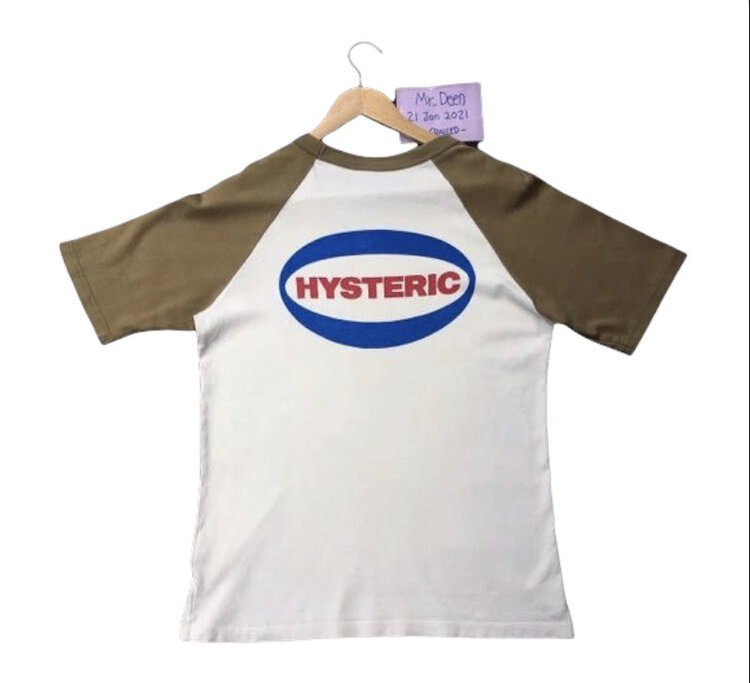
(Hysteric Glamour clothing pieces)
Founded by Kitamura in 1984, the brand is known for its combination of punk and pop culture as it takes on a more provocative and gaudy way of imagery on its clothing. Hysteric Glamour as a brand is very niche and is voluntarily detached from the traditional western style. The brand gained hype amongst Japan when the editors of Olive, a Japanese women's magazine published the brand which in turn gained the attention of Japan’s “anti fashion” movement. The brand was one of the main alternative cultural forces behind the Harajuku style that took Japan by storm. At this point in time the rebellious movement against traditional tailoring was becoming more and more recognized and Hysteric Glamour was the right brand to lean into during this movement. Consumers were hungry for counter cultural streetwear that the brand categorized into t- shirts, and graphic hoodies, now known as “rebellious streetwear”. Hysteric Glamour gave inspiration for new generations and brands like BAPE and UNDERCOVER to come about and thrive a decade later in the world of streetwear.

(credit: Pinterest)
Hysteric Glamour draws from obscure graphics that can be seen as obscene. Its graphic direction drew a big crowd as it encompassed the likes and fascinations of anti establishment punk slogans, psychedelia, indie comic books, and 70s pornography--all things present in American culture.
Kitamura also drew inspiration from the bold, imaginative artist, Andy Warhol. Warhol was a big inspiration for Kitamura and in actuality Warhol really liked Kitamura's work. However, before Kitamura could meet his idol, Warhol had sadly passed on. Though the two creatives never got to meet, Kitamura eventually got to collaborate with The Warhol Foundation on a collection of apparel. Many of these pieces are still available on resale sites today. Warhol's contribution to Kitamura's work is still heavenly infused today.
Furthermore, Hysteric Glamour In 2013 Hysteric Glamour was in collaboration with Playboy, which explored the vintage eroticism, which the brand has infused in it’s style. Hysteric Glamour also collaborated with Supreme in the Fall/Winter 2017 collection, and Spring 2021 collection. Given these great collaborations, Hysteric Glamour has become a cult label that has become unmistakably mainstream. Sure, these collaborations keep the brand relevant and seen, however for Hysteric Glamour it is a telling way of showing how the brand itself can still remain the same with its eccentric flare while still being quote on quote anti fashion whilst having a cult like following. Their flare in collaboration with established creators gives the brand a great advantage, even with its “anti fashion” movement the brand is still able to implement their message whilst still reinventing themselves with the likes of SUPREME and Playboy.

(Hysteric Glamour x Supreme)
Hysteric Glamour currently runs over 20 retail outlets in Japan and can also be purchased online through its own e-commerce platform and ZOZOTOWN. However, it’s popular in the states to purchase Hysteric Glamour through resale sites like Grailed, Ebay, or Farfetch. For a short time in the 80’s, Hysteric Glamour had an outlet shop in New York’s East Village, however it shut down just two years after it being there.
Now in his mid-50s, Kitamura has continued to work on many projects for artists, musicians, film makers and other brands. Given Kitamura has the ability to maintain a cult like status for his brand and reject the mainstream, it is clear that Kitamuara and Hysteric Glamour as a brand is credible, as they continue to help in pioneering brands and inspire today's generation of streetwear.

(credit: Pinterest)
Kitamura’s decision to not give into the conservatism of fashion proved to be successful as he not only paved his own path that could actually exist without the mainstream but also for the rebellion and raw aesthetic creators that could expand more through the culture themselves. Furthermore, it enhanced the number of like minded creators outside of Japan to cultivate their own mainstream that involved creative figures, art, and publications that always kept an open opposition to the mainstream media.


Comments